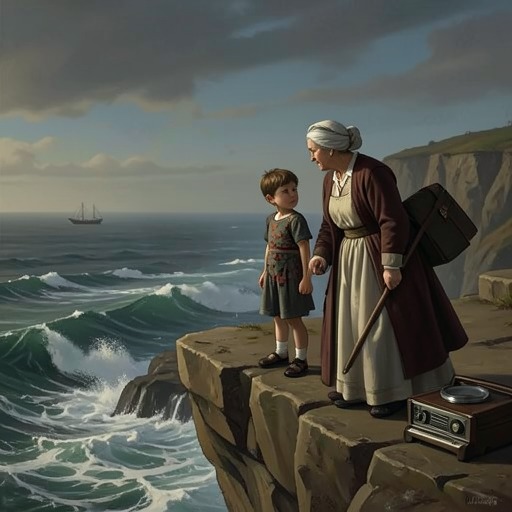
Sophia and Grandmother’s channel-marker climb
The Summer BookSophia and Grandmother’s channel-marker climb is a small island episode in which a child’s uncertain ascent and an older woman’s physical limitations briefly place each in the other’s care. Sophia climbs high enough to frighten Grandmother, but Grandmother’s effort to keep her calm—and Sophia’s return for the fallen walking stick—turn the incident into an exchange of courage, restraint, and practical help.
The marker and the ascent
The channel marker is a high, white structure made of widely spaced horizontal planks, with a red triangle in its middle. Sophia uses the planks as rungs. The gaps are so broad that her legs only just reach from one to the next, and after each step her knees shake slightly; she waits for them to steady before climbing again. By the time Grandmother notices, Sophia is almost at the top.
The careful account of each rung makes the climb less a sudden leap than a sequence of small decisions. Sophia has reached a height where the next move matters, but she continues slowly, pausing between steps. Grandmother sees that she is frightened. The sun’s heat makes the marker appear to shimmer and quake, an effect that accompanies Sophia’s halt with her hands over the top plank. She has reached the uppermost rung, but does not move beyond it.
Grandmother’s response
Grandmother immediately understands that shouting could startle Sophia. Although she considers the climb not dangerous in itself, she knows the child is scared and decides to wait for her to come back down. The distinction matters: Grandmother’s concern is not that the marker is certain to cause a fall, but that alarm might turn a manageable climb into a more perilous one. Her first response is therefore restraint.
When Grandmother stands too quickly, her walking stick rolls into the pool. The rock beneath her seems uncertain to her, and she cannot simply go after the child or retrieve the stick herself. She calls encouragement—“You’re doing fine,” and tells Sophia she is almost there—then asks her to come back down. Sophia remains still. Grandmother calls again, explaining that the stick has fallen and that she cannot walk without it. Her balance, she says, is especially poor that day, and she needs her cane.
The appeal changes the immediate problem without requiring Grandmother to shout in panic. Instead of urging Sophia onward toward the top, she gives her a reason to descend: Grandmother needs help. The request also makes her own difficulty explicit. The climb has exposed the older woman’s dependence on the stick at the same moment that Sophia is managing her fear on the marker.
The return and recovery
Sophia begins her descent and moves steadily, one step at a time. The measured pace that carried her upward also brings her safely back to the rock. She then wades into the pool, retrieves Grandmother’s stick, and hands it to her without looking at her. Her help is concrete and immediate; the episode ends not with a reprimand for climbing but with the restoration of the object Grandmother needs to move about.
Grandmother calls Sophia a very good climber and says she was brave because Grandmother could see she was scared. The praise acknowledges both parts of the feat: Sophia climbed, and she did so while afraid. Grandmother then asks whether she should tell Sophia’s father about it. Sophia shrugs and answers, “I guess maybe not,” before suggesting that Grandmother can tell the story on her deathbed so it will not go to waste. Grandmother accepts the joke as a good idea and walks across the rock to sit beside the air mattress, just outside the violet parasol’s shade.
Significance of the episode
The scene reverses the expected direction of assistance without making either character simply helpless or in command. Grandmother first protects Sophia by managing her own alarm; when her stick falls and her balance is poor, she asks Sophia for help. Sophia, in turn, does not remain frozen at the top: she descends carefully and retrieves the stick. The two characters’ different physical capacities become part of the action, not a reason to reduce the scene to danger alone.
The exchange also gives the climb a deliberately modest afterlife. Grandmother’s praise recognizes Sophia’s fear rather than pretending it was absent, while Sophia’s deathbed remark converts a frightening moment into a story the two can share. Grandmother’s final agreement leaves the incident neither solemn nor dismissed: the climb mattered enough to be remembered, but its telling can wait for comic effect. In this compact episode, risk, bodily limitation, reassurance, and humor are held together through the practical sequence of climbing down and returning the stick.